For most recent Blog check out the new website.
http://www.Tattoo-Apprentice.com/
I will see if it works out that I will post the blog on both sites,
but I am still new to this whole "blog" thing - and I will do my best.
I know for sure you can get the most recent stuff on the Tattoo Apprentice website.
Showing posts with label tattoo apprentice. Show all posts
Showing posts with label tattoo apprentice. Show all posts
Monday, April 19, 2010

Tuesday, March 30, 2010
Don't let the tattoo client bite off more than he/she can chew
An important thing to remember as a young apprentice in the tattoo industry is customer's intentions change as the progression occurs. This means that when a new client comes in they are optimistic on their design concept and the size / complexity of that design. They have quality as a priority initially, but as the pain sets in so does the reality of the tattoo. Soon the optimism turns to a re-prioritization where the time you (the artist) are taking can almost seem to anger the clients.
This is very common and it is your job to do a few things:

1.) Don't oversell the tattoo. If you know it will take 6 hours, then tell them it will take 6 hours.
2.) Learn your clients. If your client is new (even worse is first timer or virgin) then you have to bring them back down to earth usually.
3.) Educate them, but don't belittle them.
4.) If the tattoo turns to resentment during the process, stay calm and work out a compromise - even if it means setting up a second follow up appointment.
Always make sure you get the deposit before they leave for the follow up or you might not see that client for a very long time. This is not so much as a business practice in getting the customer's money, as it is for the "you don't want someone walking around with bad art on their body that you did" sort of reason.
Keep in mind that these things happen, and it is your job to prevent them before they happen. Educate your new customers, they will thank you for it later!
This is very common and it is your job to do a few things:

1.) Don't oversell the tattoo. If you know it will take 6 hours, then tell them it will take 6 hours.
2.) Learn your clients. If your client is new (even worse is first timer or virgin) then you have to bring them back down to earth usually.
3.) Educate them, but don't belittle them.
4.) If the tattoo turns to resentment during the process, stay calm and work out a compromise - even if it means setting up a second follow up appointment.
Always make sure you get the deposit before they leave for the follow up or you might not see that client for a very long time. This is not so much as a business practice in getting the customer's money, as it is for the "you don't want someone walking around with bad art on their body that you did" sort of reason.
Keep in mind that these things happen, and it is your job to prevent them before they happen. Educate your new customers, they will thank you for it later!
Thursday, March 4, 2010
Whats up?

So what will be in the new book, and why is it taking so long?
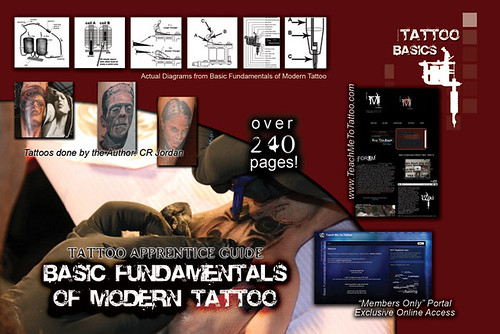
The new tattoo book (the follow on to Basic Fundamentals of Modern Tattoo) will cover a lot of stuff. Part of why it is behind schedule is because I am really trying to make sure you get your money worth on this one. This book will not replace Basic Fundamentals of Modern Tattoo, but it will be the next book in the series. Basic Fundamentals was designed to work with the tattoo apprentice who is in a studio studying under a professional. It has a lot of information, but you need to have those hands on experiences. I am realistic though and I know a lot of people who purchased the book are not tattoo apprentices in the formal respect. That is okay, I am not one of those people who will condemn a new artist in the industry because he/she did not start off their career as a formal apprentice. I know this is a feat in itself to obtain.
The goal is to get the information out there, and make sure it is the best quality information that is easy to understand. Tattoo is a profession where you have to really study under another artist who you respect and who’s style you want to emulate or pull from (to an extent). It is difficult to get an apprenticeship in the tattoo industry though, and you (the apprentice) might be forced to take what you can get (know that this is a bad thing and it goes both ways, sometimes artists take on apprentices that they wish they could do better as well). You really just have to make sure you learn what you can from whoever will teach you. Even an artist, who does not have the best “artistic” skill, might be very technical – or have his own set of tips and tricks that you can eventually apply. As a new tattoo artist / apprentice you should always be humble and take everything you can like a sponge – just keep your mouth shut and smile and nod.
The new book will really go more into a case study and style theory, where I will take you through a bunch of tattoos (mostly grey wash, grey and white, and simple color) from start to finish. Breaking down everything that occurs each step of the way and how each machine is setup. Each tattoo will also have a medium resolution video on the web site to go along with the book with detailed audio commentary. I will also go over tattoo machine building and setup in extensive detail. I will show you a very simple way to break down every aspect of your tattoo machine and ensure that you can remain consistent. I will give you a breakdown of parts to buy – and the vendors. In Basic Fundamentals of Modern Tattoo I give a list of each quality vendor, but I really try to avoid recommending specifics (other than what I use). In the new book, I will not only use a single frame (that costs under $80.00) to build 4 different tattoo machines, but I will show you how to mix and match machine parts to get the exact desired results. I also will go over specifics about important aspects of setting up the machine (not just the tuning aspect) but the way I ride my springs and how I set the needles up in the machines, as well as what are the best disposables to use for each job.
My goal for tattoo books is that we are beyond an age where you can just have a book. You need to have a rich media experience, and that means you should get reading materials as well as audio materials and videos.
I know I am the type of person who hates to pay $100.00 for a eBook or PDF – If I am paying more than $50.00 for a book, I want to have a tangible copy of that book that I can highlight and read while I am laying in bed (yes I know I can use my laptop in bed) but there is just something about a paper book that cannot be matched. I also know that books can not show you everything that a video or audio clip can. But you have to remember that a video or audio clip or even a really good forum can’t give you that feedback that you will get from a real human mentor in a tattoo studio.
Why is it taking so long to get these titles out / update the portal?
I am still in Afghanistan – so I have limited time to work on these projects. Please stick with me though, I am serious about this industry and I am serious about trying to provide the best gear and texts that I can. Remember, if you have purchased one of my texts – you can email me directly and I will respond!
Monday, February 15, 2010
Tattoo Machines Cost Big Bucks - Or do They?
Is a tattoo machine that costs $49.00 in a catalog just as good as a $500.00 one that you can only purchase if you work in a real studio?
The short answer: Yes and No.
The long answer... where do I start?
Tattoo machines, or tattoo guns (depending on who you apprenticed under) are the devices that put the ink in the skin. A needle hooks up to them in some fashion and they are usually run by coils, magnets, and magic. The device is actually really simple and does not take a PHD in Electro-Magnetic Physics or Engineering to grasp the concept.
So how can a cheap machine be like an expensive machine?
It is all about how you tune the machine.
A machine that is made of higher grade materials (especially the coils and the springs) will make it easier to tune. If you paint then you understand the difference between cheap and higher grade oils. If you drive a car then you know the difference between a Honda Civic and a Jaguar XK. Both of those cars will get from point A to point B, by the way. It is the same concept with tattoo machines. My first tattoo machines were cheap ones from Superior, and I didn't know about upper class machines like Pulse or Eikon or Hand mades (custom irons). Once I got decent
with my Superior machines, I graduated to a set of Micky Sharpz and Dany Fowler Time Machines. I really can not say a bad thing about any of the machines I have used.
Now that I am comfortable with my gear I rely on my Superior machines more than any other machines. I have replaced the coils and the springs, but the frame is still superior. I love the weight and the vise grip is tried and true old school style. When you apprentice under an artist in a tattoo studio, check out all the different machines used by all the different artists in the studio. You will notice that there is a big difference not only in quality, but the weight and balance as well. You will also see that the power supply makes a world of difference.
What power supply is the best? There is no "Best" power supply or Machine. You have to use what YOU like and what YOU can get the job done with. Check out the Basic Fundamentals of Modern Tattoo - there is a whole chapter in there where I go over all my gear and why I use the stuff I use.
You will always shave new machines coming out, and you can see on the top artist's forums or the big conventions like Hell City. This is a professional trade it requires that you stay on top of the new technology (yes I said technology) that is constantly being introduced into the market.
You don't have to do a proper tattoo apprenticeship, but you will spend years researching and trying to figure out what makes a Cheap Priced tattoo Machine top notch.
A lot of these things come from experience, and I can honestly say that a majority of PROFESSIONAL tattoo artists do not know their machines they way they should.
You have a select class of tattoo artists who will consider themselves tattoo machine builders. The have the "Secrets" to the coil wraps and the harmonic balance of the metals and the geometry... but It is the author's opinion that every tattoo artist should be able to differentiate between a good tattoo machine and a poorly crafted one (as it applies to their specific style of tattoo).
So get out there and start researching and talking to your fellow apprentice's (is that the plural for apprentice? probably not..)
The short answer: Yes and No.
The long answer... where do I start?
Tattoo machines, or tattoo guns (depending on who you apprenticed under) are the devices that put the ink in the skin. A needle hooks up to them in some fashion and they are usually run by coils, magnets, and magic. The device is actually really simple and does not take a PHD in Electro-Magnetic Physics or Engineering to grasp the concept.
So how can a cheap machine be like an expensive machine?
It is all about how you tune the machine.
A machine that is made of higher grade materials (especially the coils and the springs) will make it easier to tune. If you paint then you understand the difference between cheap and higher grade oils. If you drive a car then you know the difference between a Honda Civic and a Jaguar XK. Both of those cars will get from point A to point B, by the way. It is the same concept with tattoo machines. My first tattoo machines were cheap ones from Superior, and I didn't know about upper class machines like Pulse or Eikon or Hand mades (custom irons). Once I got decent
with my Superior machines, I graduated to a set of Micky Sharpz and Dany Fowler Time Machines. I really can not say a bad thing about any of the machines I have used.
Now that I am comfortable with my gear I rely on my Superior machines more than any other machines. I have replaced the coils and the springs, but the frame is still superior. I love the weight and the vise grip is tried and true old school style. When you apprentice under an artist in a tattoo studio, check out all the different machines used by all the different artists in the studio. You will notice that there is a big difference not only in quality, but the weight and balance as well. You will also see that the power supply makes a world of difference.
What power supply is the best? There is no "Best" power supply or Machine. You have to use what YOU like and what YOU can get the job done with. Check out the Basic Fundamentals of Modern Tattoo - there is a whole chapter in there where I go over all my gear and why I use the stuff I use.
You will always shave new machines coming out, and you can see on the top artist's forums or the big conventions like Hell City. This is a professional trade it requires that you stay on top of the new technology (yes I said technology) that is constantly being introduced into the market.
You don't have to do a proper tattoo apprenticeship, but you will spend years researching and trying to figure out what makes a Cheap Priced tattoo Machine top notch.
A lot of these things come from experience, and I can honestly say that a majority of PROFESSIONAL tattoo artists do not know their machines they way they should.
You have a select class of tattoo artists who will consider themselves tattoo machine builders. The have the "Secrets" to the coil wraps and the harmonic balance of the metals and the geometry... but It is the author's opinion that every tattoo artist should be able to differentiate between a good tattoo machine and a poorly crafted one (as it applies to their specific style of tattoo).
So get out there and start researching and talking to your fellow apprentice's (is that the plural for apprentice? probably not..)
Sunday, February 14, 2010
How do I become a tattoo artist?
Reality TV shows, Tattooed musicians, Tattoo Flash Design website, Online Tattoo Supply superstores… Tattoo has been everywhere for the past 5 years or so. Is the industry finally calming down from this cyclical bump? You get the groups of tattoo artists who will tell you, “I hope so – we have too many scratcher wanna’be tattoo artists already.”
You get the groups of tattoo artists (less often) who will tell you that the business is one of those types that will go up in a down economy. Its hard to talk about anything these days without hearing about the big “E” word. Yup, economy is embedded in our 2010 vocabulary now.
You see a ton of tattoo artists out there trying to get their books and DVDs out as well. I know that there are a lot of young people (young in tattoo years) who want to get involved in tattooing. What does it take to get into the tattoo scene? Is there really money in the tattoo industry? Do you really need artistic talent to be a tattoo artist? Do you really need to do a proper apprenticeship? Is a tattoo machine that costs $49.00 in a catalog just as good as a $500.00 one that you can only purchase if you work in a real studio? These are all good questions that the new tattoo artist really wants to know about, and if you are anything like I was 10 years ago then you are scouring for information about tattoo everywhere (and that includes the internet).
What does it take to get into the tattoo “scene”? – It takes a lot of patience and observation. You have to check out a lot of studios, perfect your drawing and painting skills, get a ton of tattoos on your own body, and talk to artists. You have to really be dedicated and also be smart. You can easily be taken advantage of as a young apprentice by someone who might not even intend to teach you anything about tattoo.
Is there money to be made as a tattoo artist? – Kinda sorta not really… Sure there are tattoo artists who charge a ton of money, but they are really saught after professionals who have made a name for themselves. What a lot of young artists don’t realize right off the jump is that you really make your money doing the small stuff. Small stuff being the tribals, scripts, hearts, flowers, flash, flash, flash, and until you are sick of it… flash. It sucks, but if you are all about the money aspect of tattoo then get used to doing what I call “yard work”. Those of us who love the craft and trade of tattoo will gladly do a sleeve for someone for next to nothing (so long as our own bills are already in the green). It depends on the piece though. Art is art, and if you are an artist then you will love the art you do. Beware getting into tattoo thinking you are going to do awesome tattoos that are multi session and cost big bucks right off the jump. (don’t forget you have to give the studio owner his cut of the $ as well).
What about talent? – Yes and No.. I know a lot of tattoo artists who are not very good artists, but they make a living. They don’t get to do the fun stuff, but I think those guys are the ones who don’t really care about the trade that much to begin with anyway. If you think you are good at one medium (ie painting or pencil) then you will really test yourself ot learn the tricks of tattooing. It take a lot of time and practice. It is not like paper where you can just rip it up and start over either. You need to have well planned pieces and execute them in a timely manner and keep it clean. The more artistic ability you have the better off you will be. Art is subjective though, so what one guy thinks is good – another might think is not.
I will hit on the machines, apprenticeship, and other stuff in a later blog. I do go into a lo tof this stuff in my book Basic Fundamentals of Modern Tattoo, in a no B.S. way that will help you get the un-sugar coated truth about what it takes and how you should go about becoming a tattoo professional. (Not just another tattooer who traces flash all day)
You get the groups of tattoo artists (less often) who will tell you that the business is one of those types that will go up in a down economy. Its hard to talk about anything these days without hearing about the big “E” word. Yup, economy is embedded in our 2010 vocabulary now.
You see a ton of tattoo artists out there trying to get their books and DVDs out as well. I know that there are a lot of young people (young in tattoo years) who want to get involved in tattooing. What does it take to get into the tattoo scene? Is there really money in the tattoo industry? Do you really need artistic talent to be a tattoo artist? Do you really need to do a proper apprenticeship? Is a tattoo machine that costs $49.00 in a catalog just as good as a $500.00 one that you can only purchase if you work in a real studio? These are all good questions that the new tattoo artist really wants to know about, and if you are anything like I was 10 years ago then you are scouring for information about tattoo everywhere (and that includes the internet).
What does it take to get into the tattoo “scene”? – It takes a lot of patience and observation. You have to check out a lot of studios, perfect your drawing and painting skills, get a ton of tattoos on your own body, and talk to artists. You have to really be dedicated and also be smart. You can easily be taken advantage of as a young apprentice by someone who might not even intend to teach you anything about tattoo.
Is there money to be made as a tattoo artist? – Kinda sorta not really… Sure there are tattoo artists who charge a ton of money, but they are really saught after professionals who have made a name for themselves. What a lot of young artists don’t realize right off the jump is that you really make your money doing the small stuff. Small stuff being the tribals, scripts, hearts, flowers, flash, flash, flash, and until you are sick of it… flash. It sucks, but if you are all about the money aspect of tattoo then get used to doing what I call “yard work”. Those of us who love the craft and trade of tattoo will gladly do a sleeve for someone for next to nothing (so long as our own bills are already in the green). It depends on the piece though. Art is art, and if you are an artist then you will love the art you do. Beware getting into tattoo thinking you are going to do awesome tattoos that are multi session and cost big bucks right off the jump. (don’t forget you have to give the studio owner his cut of the $ as well).
What about talent? – Yes and No.. I know a lot of tattoo artists who are not very good artists, but they make a living. They don’t get to do the fun stuff, but I think those guys are the ones who don’t really care about the trade that much to begin with anyway. If you think you are good at one medium (ie painting or pencil) then you will really test yourself ot learn the tricks of tattooing. It take a lot of time and practice. It is not like paper where you can just rip it up and start over either. You need to have well planned pieces and execute them in a timely manner and keep it clean. The more artistic ability you have the better off you will be. Art is subjective though, so what one guy thinks is good – another might think is not.
I will hit on the machines, apprenticeship, and other stuff in a later blog. I do go into a lo tof this stuff in my book Basic Fundamentals of Modern Tattoo, in a no B.S. way that will help you get the un-sugar coated truth about what it takes and how you should go about becoming a tattoo professional. (Not just another tattooer who traces flash all day)
Subscribe to:
Posts (Atom)